Research
My recent work centers on AI-driven power and energy system decision-making, including dispatch-oriented modeling, uncertainty-aware optimization, and flexibility assessment based on real-world datasets.
1. AI-Driven Power System Modeling and Optimization
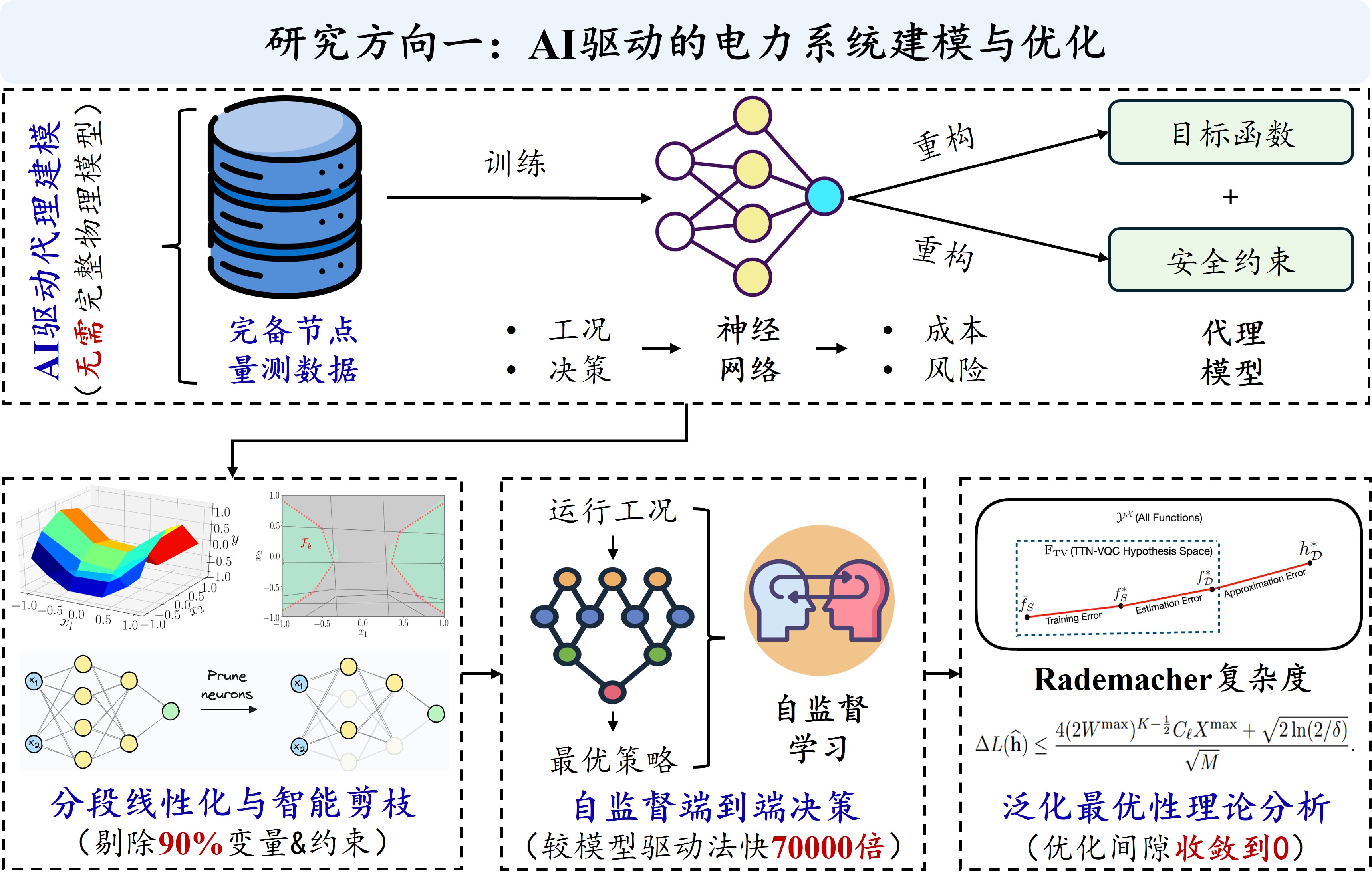
This line of research studies how to build dispatch models directly from measurements, improve their computational efficiency, and understand their theoretical performance. The goal is to support power-system optimization even when physical parameters are incomplete or hard to obtain, by learning the relationship among operating conditions, dispatch actions, objectives, and security constraints from data.
Representative work in this direction includes AI-driven dispatch model construction from complete node-level measurements, intelligent pruning for reducing redundant variables and constraints, self-supervised end-to-end dispatch learning, and theoretical upper-bound analysis for model generalization and optimization loss.
Selected papers
- [J1] Replicating Power Flow Constraints Using Only Smart Meter Data for Coordinating Flexible Sources in Distribution Network, IEEE TSTE, 2024.
- [J2] Scheduling Thermostatically Controlled Loads to Provide Regulation Capacity Based on a Learning-Based Optimal Power Flow Model, IEEE TSTE, 2021.
- [J3] Constraint learning-based optimal power dispatch for active distribution networks with extremely imbalanced data, CSEE JPES, 2024.
- [J4] Efficient constraint learning for data-driven active distribution network operation, IEEE TPWRS, 2024.
- [J5] Model-free self-supervised learning for dispatching distributed energy resources, IEEE TSG, 2025.
- [J6] Neural Risk Limiting Dispatch in Power Networks: Formulation and Generalization Guarantees, IEEE TPWRS, 2025.
2. AI-Driven Uncertainty Modeling and Risk-Aware Dispatch
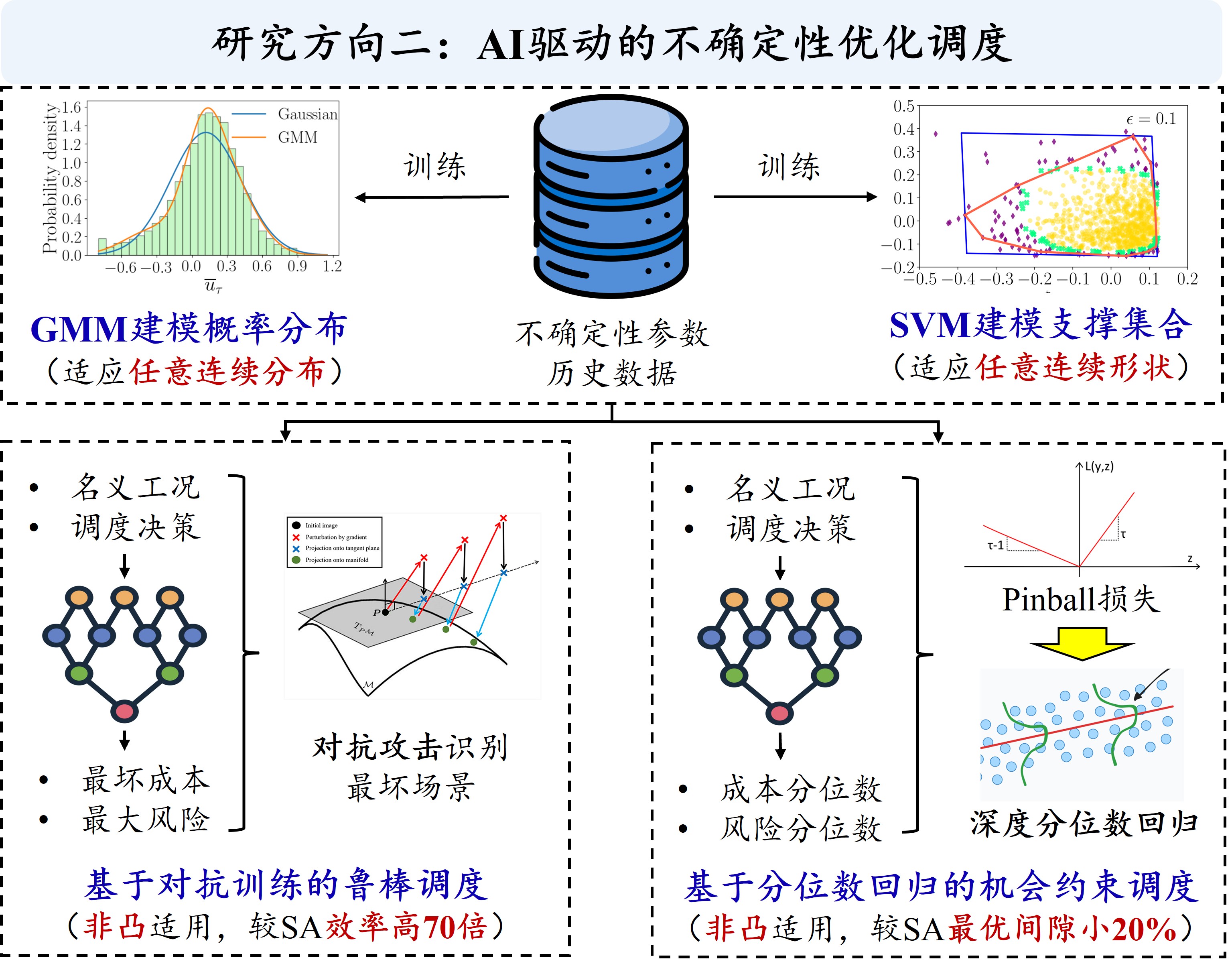
This direction focuses on how to model uncertainty in renewable generation, load behavior, and operating conditions, and how to defend against the resulting dispatch risk. The core idea is to combine data-driven uncertainty representation with optimization techniques such as robust optimization and chance-constrained programming.
Representative studies include Gaussian-mixture and support-set based uncertainty modeling, risk-aware dispatch under distributional ambiguity, adversarially robust dispatch learning, and fast surrogate modeling for chance-constrained optimization under non-Gaussian uncertainty.
Selected papers
- [J7] Chance-constrained regulation capacity offering for HVAC systems under non-Gaussian uncertainties with mixture-model-based convexification, IEEE TSG, 2022.
- [J8] Fast Wasserstein-distance-based Distributionally Robust Chance-Constrained Power Dispatch for Multi-Zone HVAC Systems, IEEE TSG, 2021.
- [J9] Scheduling HVAC loads to promote renewable generation integration with a learning-based joint chance-constrained approach, CSEE JPES, 2023.
- [J10] Adversarial constraint learning for robust dispatch of distributed energy resources, IEEE TSTE, 2025.
- [J11] Deep-quantile-regression-based surrogate model for joint chance-constrained optimal power flow with renewable generation, IEEE TSTE, 2023.
- [J12] Time-efficient strategic power dispatch for district cooling systems considering the spatial-temporal evolution of cooling load uncertainties, CSEE JPES, 2022.
3. Real-Data Vehicle-Grid Interaction and Flexibility Assessment
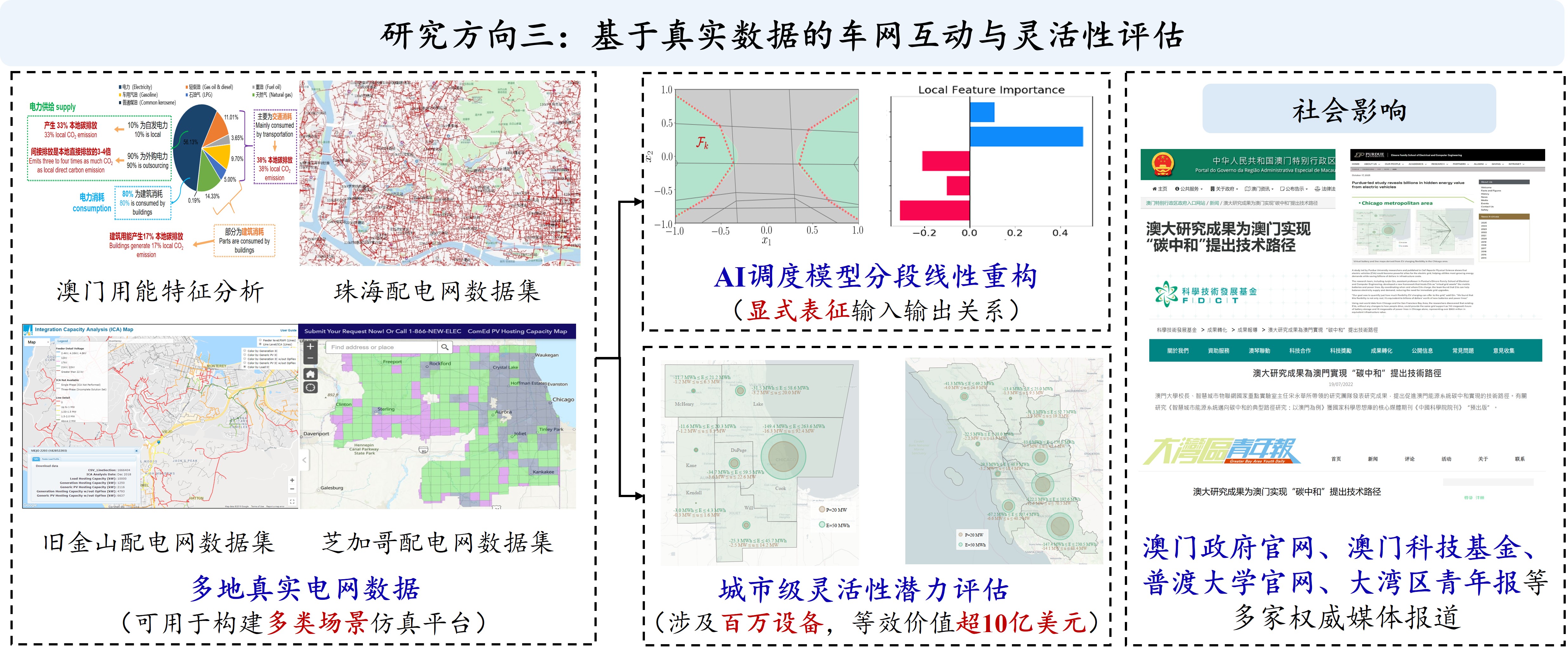
This direction studies how interpretable AI and real-world operational data can support system-level flexibility evaluation. Beyond model construction, the emphasis here is on understanding decision logic, quantifying flexibility potential in practice, and assessing the societal and engineering value of electrified transportation and real energy systems.
Representative studies include post-hoc interpretability analysis for AI dispatch models, flexibility assessment in practical regional systems, data-driven evaluation of EV charging and shared-fleet value, and application-oriented studies with demonstrated societal impact.
Selected papers
- [J4] Efficient constraint learning for data-driven active distribution network operation, IEEE TPWRS, 2024.
- [J13] Monetizing Shared EV Fleets through Demand Charge Reduction Services, IEEE TTE, 2026.
- [J14] Electric Vehicles as Virtual Grid Assets: Quantifying Spatiotemporal Charging Flexibility to Accelerate Sustainable Energy Transition, Cell Reports Physical Science, 2025.
- [J15] Typical Pathway to Carbon Neutrality for Urban Smart Energy Systems: Case Study of Macao, Bulletin of Chinese Academy of Sciences, 2022.